anime, science + tech

kana computer mod

ah…and they wonder why computer nerds and anime otakus equally have less than ideal reputations. from the pages of gizmodo comes this kind of interesting/kind of disturbing case mod for a computer. katsuya matsumura, who is most likely both an anime fan and an avid computer enthusiast, built a whole anime maid/model out of poly-styrene and clay to house computers. and not only is it absolutely kawaii, its also got the obligatory fan service (aka: panty shot). it also looks life-sized and appropriately under-aged. katsuya…you are both absolutely coo, yet also quite frightening. maybe he’ll make a chobits model next.

> kana computer case (via gizmodo)
> matsumura katsuyas website

archive | favorites, science + tech

mega power armour

yay…its like a weeks worth of techno coo-ness. following last weeks hyper-unit neo-washaru 2000-zeta and yesterdays future tech post comes the rockin’ powersuit BLEEX. wired has an interesting article today on the BLEEX (berkeley lower extremity exoskeleton), a powered exoskeleton being developed by uc berkeley that augments a wearers strength. the exoskeleton, which sounds very similar to the robo-pants mentioned in the neo-washaru post, is composed of robotic legs, a power unit, and a large backpack. sensors and hydraulics in the exoskeleton keep track of weight distribution throughout the frame so it never feels like the wearer is lifting anything strenuous. according to the article, testers were able to walk around with the 100 lb frame and 70 lb backpack and only felt as if they were carrying around 5 lbs. woo. all the sci-fi lovers out there are probably already imagining running across rooftops, running at 100mph, and viciously ripping evil robots heads off. but the unit at the moment is being geared towards soldiers, fire-fighters, and rescue crews carrying heavy loads over large distances. whatever…the second they develop an upper-body exoskeleton too, what we have is a power suit that you can mount chainsaws, rail guns, and bfg 2000’s onto and run around blowing up invading alien matrix armies bent on opening portals to hell and merging to form devastator. woo-fucking-ha.

and on a sidenote, what the heck is wrong with these researchers? why do they always give these ridiculously coo technologies retarded acronym names? HIRB? BLEEX? wankers. toss that shit out the window. we’re re-christening it the super-dimensional mega power armour. rock on.

> super-dimensional mega power armour (via wired)
> BLEEX project website

science + tech

welcome to the future

in more news from the future, my silver space suit is ready to pick up from the dry cleaners and my bubble helmet is getting a shine. yay! i think the future will be solidified in my simple raised-in-the-80s mind when one of these projects becomes a reality. popular science has an article today about some potential projects of the future that push the limits of our technology and imagination. there have already been a number of grand-scale projects in recent times, such as the massive three-gorges river damn in china, the new tallest building in the world in taipei, taiwan (which sadly looks like its ribbed…for her pleasure), and the artificial island that the chek lap kok airport in hong kong sits on. but the envisioned projects in this article trump those in spades. amongst the projects that the article looks into, of particular coo-ness were the trans-atlantic mag-lev system and the space elevator…either of which would be massive undertakings beyond anything ever done in the past.

space elevator
with the cost and risk of sending rockets and shuttles into space, scientists began devising other methods of space travel a while back. these included newer shuttle designs, a space elevator, and star trek teleportation. jk about the teleporting. but the space elevator tho…that was one of the crazier (but scientifically feasible) proposals to emerge. the idea was to shoot an anchor into space, then tethered to the earth along the equator via a cable. the cable is kept taut simply by centripetal force, which also kept the anchor in a geo-synchronous orbit. an earth-borne elevator is then lifted up via ground-based lasers and can lift payloads up to 5 tons with relative ease. craziness. whats even crazier is the distance of the elevator. the proposed length/distance of the anchor is some 62,000 miles above the earths surface. consider the international space station floating high above the earth, is a mere 250 miles above the surface of the earth and you’ll start understanding the scope of this project. at the moment, one of the major setbacks is the cable itself. there is currently no material resilient enough to withstand such centripetal forces…except nanotube technology. the problem is that the longest nanotube currently ever created was only a few microns long. but research is already underway to combine nanotubes with epoxy resin and then extruding it. there are however other issues as well, such as storms, meteorites, and corrosives, not to mention the laser system itself that would elevate the payload up. craziness.

trans-atlantic service
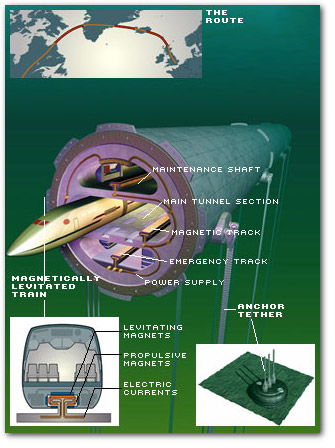
the trans-atlantic mag-lev system however is my personal favorite future project. i think it would be pretty coo to hop a mag-lev train from penn station, new york and step out of waterloo station, london an hour later. yea…an hour. the project proposes to create a series of neutrally-buoyant tunnels anchored to the atlantic seafloor, and then run a mag-lev train system thru it that can travel upwards of 5,000 mph. holy shit. a proposed route would take the train thru canada, greenland, and iceland first before barreling thru the atlantic…since land-based routes are cheaper to build than ocean-based ones. all the technology exists…the only limitation currently is the cost. at approximately $50 million a square mile, the project is estimated to be as much as $175 billion. poot. but as researcher ernst frankel states, “A transatlantic tunnel will be done. We just have to be as interested in it as we are in getting to the Moon.” woo to the future…

> future projects (via pop sci)

science + tech

roujin z is here

you know…ive been waiting how long for the future to arrive? im currently still scouting for a silver jumpsuit with bubble helmet, but for the time being we get to marvel at the latest in elderly-care technology in japan. an article today in the ny times looks at some new technologies emerging in japan to aid the elderly, such as sanyos HIRB human washing machine (it stands for “harmony in roll-lo bathing”…whatever), a pair of powered robotic pants that allows the wearer to walk more freely, and a mobile “wakamaru” robot nurse that keeps an eye on the elderly. crazy shit yo. the HIRB human washing machine in particular is pretty interesting. the elderly sit in a chair, “merge” with the wash unit, and the unit seals itself around them from the neck down and begins to clean them. its like a cyber-cleaning suit! well…a stationary one anyway. they couldve made it more future-y by naming it something swishy and anime-esque, like “hyper-unit neo-washaru 2000-zeta!!!” the acronym HIRB isnt nearly as swish…but the things still pretty coo.
the HIRB and the robot pants actually reminded me of a japanese anime from 1991, roujin-z…which was about a hyper-super-neo!!! hospital bed that transforms into a robot, takes on the personality of its occupants deceased wife, and then takes him on a rampage through the city because the elderly man wanted to see the beach again. weird on so many levels, but still very coo…

> robotic help in japan (via ny times)
> roujin-z info

science + tech

future tech

[ current selection | same old – same old ]
[ feelin’ | soggy ]

in the future…your cars going to tell you whether you suck at driving or not. odd premise, no? its a possibility…wired had an article today about a toyota concept car, the sportivo, that uses a personalized smart card which not only stores your seating preferences, but also your driving experience and record. if youre a newbie, or if you just plain suck at driving, the car may cut the engine performance so you dont kill yourself…or someone else. scary thought eh? its developers insist that its only a test bed for future technologies, and even tho it could potentially save alot of lives…its still an odd thought having the car second-guess your driving abilities.

and another wired tech article talked about a new microbial fuel cell that generates energy from waste water…craziness. microbial fuel cells, unlike traditional fuel cells which generally use hydrogen, utilize bacteria that metabolize food and release electrons, producing a constant stream of electricity. other microbial fuel cells have, in the past, used glucose and ethanol to generate electricity. this one, developed at penn state, uses the crap in dogwater! the technology could potentially make wastewater treatment facilities of the future perpetually self-sustaining. it kind of reminds me of the mr. fusion from back to the future, where one day, you could just toss trash from the back of your car into uh…the back of your car, to power it. given the habits of some people i know, thats enough fuel for an entire hemisphere…

> sportivo concept car (via wired)
> energy from your crap (via wired)

science + tech

the virtual world

theres a pretty interesting article today from the bbc about the u.s. army’s intent to build a virtual “second earth”…to be fully detailed and at full scale. shit. the u.s. army is currently working with the game company there to build an accurate model of the earth at full scale so theyre able to not only simulate battles, but also to “let the Army simulate intelligence work as well as patrols, planning and working with indigenous populations…”

coincidentally, theres also another article today on popular science about scientists attempting to create computer models of social thought patterns so theyre able to predict the behavior of whole populations. the way they describe the agents and coded behaviors reminded me of the “massive” program utilized for crowd control in the lord of the rings movies. individual agents were prescribed with a set of behaviors and reactions, skills and thought patterns, which helped it to determine its course of action as it independently made its way thru its environment. in the defense departments case, the pentagon has laid down some $100 million to develop the oneSAF program, a similar agent-based modelling program they hope will be able to anticipate terrorist activity. they essentially plan on replicating the enemies of the u.s. in virtual form in order to predict their behavior. quite scary.

now combine the agent-modelling with the full scale virtual earth and you have the potential to make some truly scary shit. hypothetically, they could build the full-scale earth down to every little detail, encode real-world physics, populate it with independent-thinking agent-models with prescribed behaviors, then interact with them in order to determine their behaviors and reactions in a real-life scale and environment. all virtually. this is the basis for how many movies? they could potentially even set the agent parameters, let the program run on its own, and see where society is in a hundred or so years…whether theyre bombed out or hopping from planet to planet…

> creating a second earth (via bbc)
> predicting behavior (via pop sci)

science + tech

fun with calabi-yau manifolds

[ current selection | danger mouse – encore ]
[ feelin’ | like a hit ]

while i admit to not completely understanding 99% of the things that define astrophysics, i have to say that it still fascinates me alot. the inner workings of the infinite(?) universe and the substances and energies that we dont (cant) see or describe make for good reading. michael moyer of popular science attempts to explain in (relatively) laymans terms some of the theories floating thru the realms of physics that explain how the universe ticks. he goes thru two of the primary theories of the universe…the 10-dimensions theory and the 3-dimensional brane in a 4-dimensional bulk theory. where his article tries to dumb down the theories to understandable english, ill probably dumb it down even further to pre-school levels.

calabi-yau
the first theory…the 10-dimensions, explains that the universe consists of 3-dimensions, the 4th dimension (time), and 6 more located everywhere that fold in on itself and defined as the calabi-yau manifold. the 6-dimensions were theorized after the scientists couldnt get around the fact that most of the energy of the universe is missing (unseen). and its not even a small discrepancy…as the article succinctly illustrates:

Let T be the theoretical magnitude of dark energy.
Let E be the experimental value of dark energy.
If the theorists were right, then T should = E.
Yet TE.
T = E x 10~120 (10 to the 120th power).
(10~120=1,000,000,000,000,000,000,000,000,000,000,000,000,
000,000,000,000,000,000,000,000,000,000,000,000,000,000,
000,000,000,000,000,000,000,000,000,000,000,000,000,000)

oops, just a wee difference. it goes on to use a long combination of words to explain how this discrepancy relates to the constituents of the calabi-yau manifolds. head…ouch. i think its still too early for this stuff…moving on.

branes+bulk
the other theory of 3-dimensions in a 4-dimensional bulk is a relatively new theory, having been postulated in 1998. it rose from the inescapable fact that gravity is actually a pretty pathetic force when compared to the other forces out there (electromagnetic, for example). according to theories of particle physics, they should technically be equal. so instead of explaining this inconsistency thru the current model of the universe…3 scientists just created a new dimension. they theorized that our 3-dimensions reside in a 4-dimensional bulk that we cannot travel to…that no particle can travel to, except gravitons. as more gravitons escape to this other dimension, their relative force in ours would weaken…which would explain why gravity is weaker than the other forces in our 3-dimensions. that is the decidedly dumbed down summary of it…and to explain the rest would hurt my head. if you feel your brains slowing down, have a nice read of this article to get your brain tied in knots. i need some tea.

> astrophysics for dummies (via popular science)

science + tech

giant diamonds

scientists from the harvard-smithsonian institute in cambridge have gathered evidence of a moon-sized crystal at the heart of a dying white dwarf star. their observations of the pulsations of the stars brightness led them to conclude that the core of the star was solidifying under the intense pressure of the cooling star. with this new data, the scientists hope to better understand and estimate the age of our galaxy. while this is all fine and dandy…did you read that line about the crystal being the size of the moon??? shit, that is some massive rock hotness. the scientists also noted that the crystal, while likened to a diamond, is “unlike any known on earth.”

The pressure inside the white dwarf is a million million times the pressure that produces diamonds. This pressure strips electrons from the atoms, leaving the nuclei to form a crystal lattice surrounded by a sea of electrons.

sweetness. imagine what the street value of a moon-sized crystal diamond millions of millions times more dense than a normal diamond would be. one can only wonder what other ridiculously coo things we could find out there, if only we had the starship enterprise…

> bigass diamond inside core of star (via new scientist)

science + tech

browser compatibility

note | im now 99% sure that this blog is compatible with most browsers. its always been ie-friendly, but at the reminder of wvs, i finally got off my ass and debugged it for netscape/mozilla/firefox also. mac-platform browsers…well, ill assume they work fine too. tho i cant personally vouch for it. the webmonkey post reminded me about how waaay back in the mid-to-late 90’s, i actually made a concerted effort to make my sites multi-browser friendly. i used to be a hardcore mosaic/netscape user back in “the days” (bwahaha)…and coded everything netscape-friendly (with notepad, then frontpage…heehee…then dreamweaver). ie-friendliness was always a minor afterthought. netscapes coding however slowly went poo, and i grudgingly hopped onboard the ie platform when its features eventually caught up (and were more friendly to my sites)…and ive since used ie. with the jump also went my desire to code for two platforms. during that time, id occasionally try out netscape, load up one of my sites, and watch as images just fly off the page. rock. netscape still bugs me sometimes when i code even relatively simple html, but im starting to make an effort again. anyhoo, all is kosher now…i think. any problems, shoutbox it…

ooh, and coo history of netscape…

> netscapes history
> netscape
> mozilla/firebird(fox?)

science + tech

webmonkey es muerto

[ current selection | massive attack – mezzanine ]
[ feelin’ | hungry again ]

oh shit, webmonkey is shutting down! according to todays wired news article, webmonkey is shutting down after 8 years of helping retards make webpages. bugger. originally begun back in august of ’96, webmonkey was part of a series of websites funded by the original owners of wired magazine. it helped tarts like me understand the principles of frames, tables, and various early website accoutrements. funded initially by advertising revenue, their resources dried up after the dot.com bust of 2000 and has been limping along ever since. still, they had a pretty coo run. back in the early days of the modern internet, coding was still all over the place, sites had to be optimized for differing codes in ie and netscape, the flashing text code was still around (shiver), and html still stood for “hit the motherfucking llama” in my head. webmonkey was always there to make my damn pages look swish…

> webmonkey rip 1996-2004 (via wired)
> webmonkey (still up for now…)